
Course Description
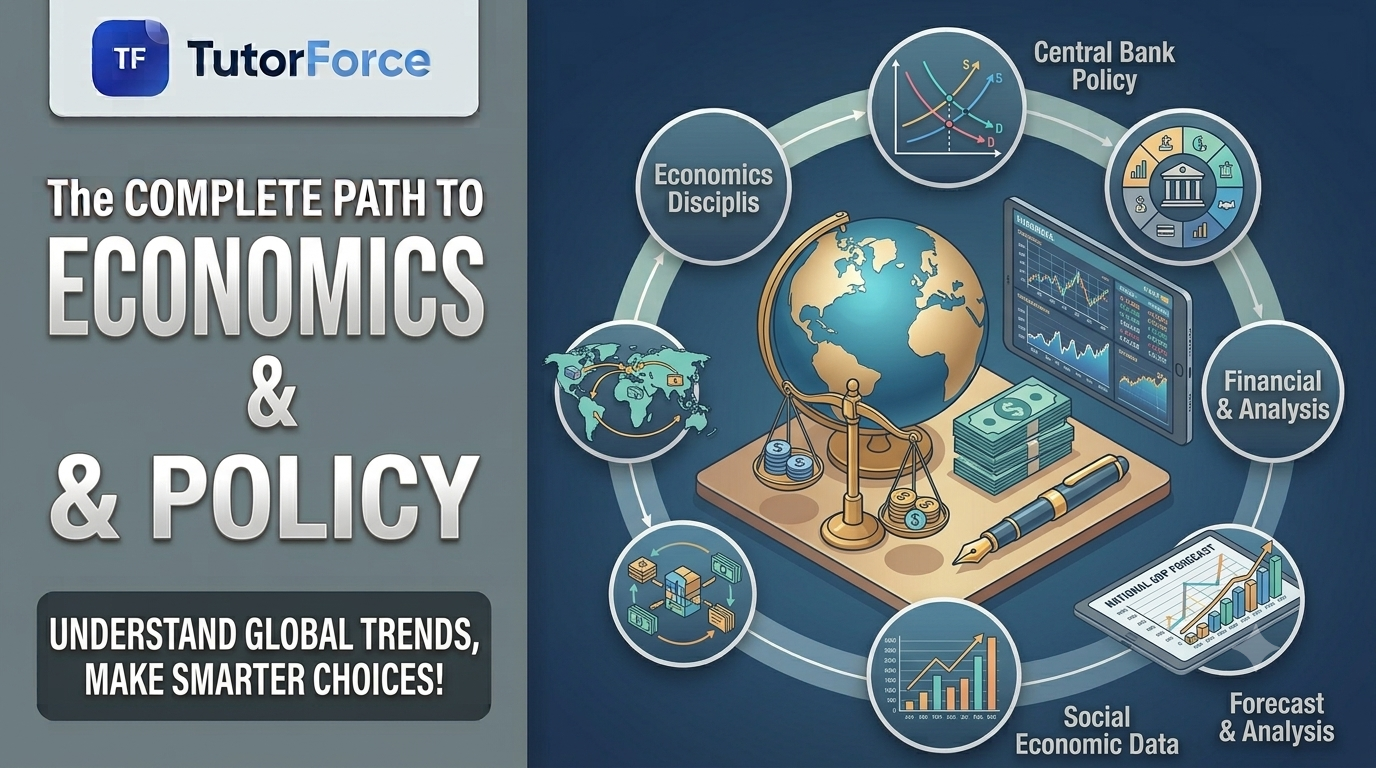
This course explores how individuals, businesses, and governments allocate scarce resources to satisfy unlimited wants and needs. Splitting focus between microeconomics and macroeconomics, you will analyze how prices are set in market systems, how individual incentives drive economic decisions, and how broad aggregate forces—such as inflation, unemployment, monetary policy, and international trade—shape national and global economies.
Core Topics
-
Scarcity, Choice, and Opportunity Cost: The fundamental economic problem, trade-offs, marginal decision-making, and production possibilities frontiers (PPF).
-
Microeconomics — Supply, Demand, and Market Equilibrium: Price determination, consumer and producer surplus, elasticity, market efficiency, and government interventions (taxes, price ceilings, price floors).
-
Market Structures and Firm Behavior: Production costs, profit maximization, and competitive dynamics across perfect competition, monopoly, oligopoly, and monopolistic competition.
-
Macroeconomics — Measuring the Economy: Gross Domestic Product (GDP), inflation metrics (CPI), unemployment dynamics, and business cycle fluctuations.
-
Macroeconomic Policy and Global Trade: Fiscal policy (taxing and spending), monetary policy (central banking and interest rates), foreign exchange rates, and comparative advantage in international trade.
FAQ
-
What is the main difference between Microeconomics and Macroeconomics? Microeconomics analyzes individual decision-makers like consumers, households, and specific firms. Macroeconomics looks at aggregate economic phenomena affecting whole nations or global markets, such as interest rates, GDP growth, and national unemployment rates.
-
Does studying economics require high-level calculus? Introductory and foundational economics relies mostly on basic algebra, graphs, and logical reasoning. Advanced quantitative economics and econometric modeling incorporate calculus and linear algebra, but the primary concepts are grounded in economic intuition.
-
How does understanding economics help in practical career environments? Economics trains you to think critically about incentives, resource constraints, market trends, and policy impacts—skills that are directly applicable in finance, consulting, public policy, business analytics, and strategic planning.
Student Ratings & Reviews