
Course Description
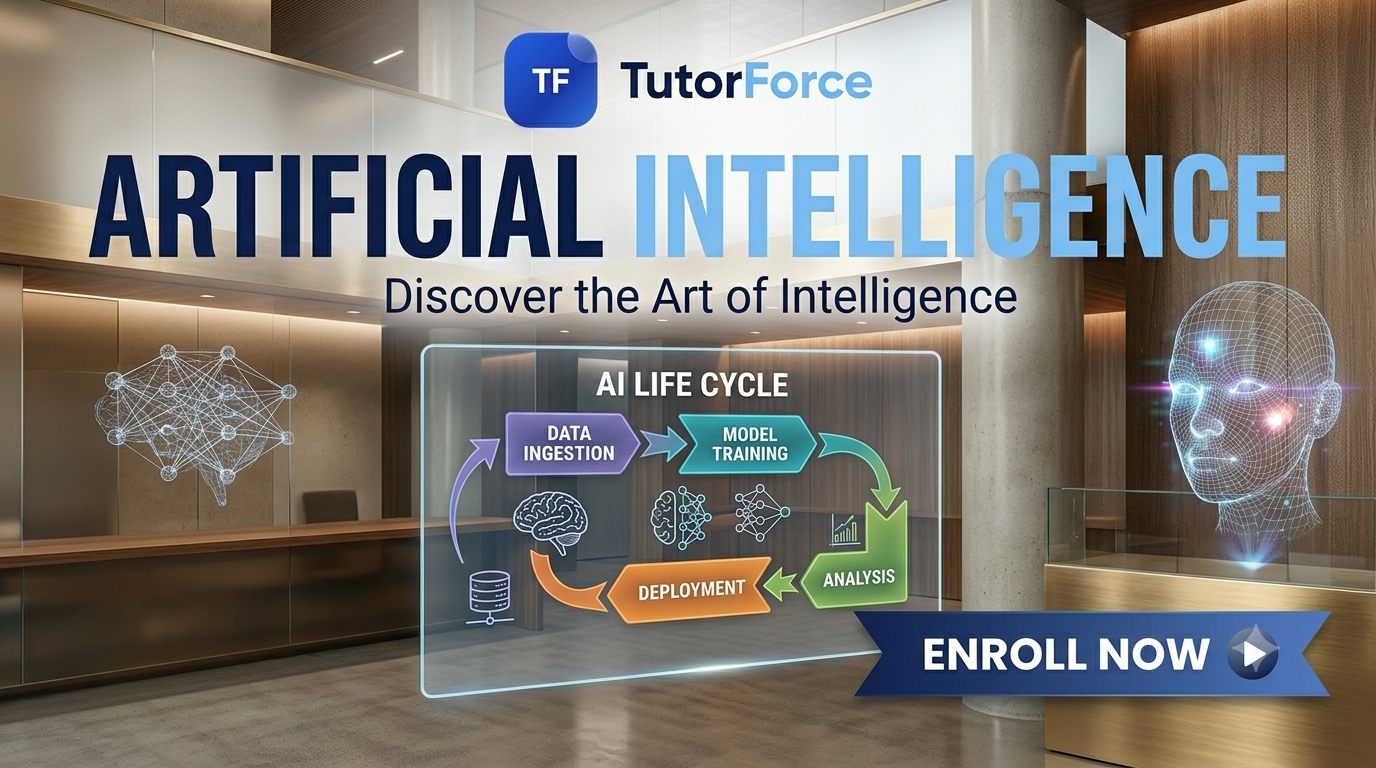
This course provides a comprehensive introduction to the core principles, algorithms, and applications of artificial intelligence. Moving past hype, you will explore how machines learn from data, recognize patterns, process human language, and make autonomous decisions. This curriculum equips you with the technical and conceptual framework required to understand, design, and evaluate modern AI-driven systems.
Core Topics
-
Foundations of Machine Learning: Supervised and unsupervised learning, model training and evaluation, overfitting vs. underfitting, feature engineering, and performance metrics (precision, recall, F1 score).
-
Deep Learning and Neural Networks: Artificial neural networks (ANNs), activation functions, backpropagation, convolutional neural networks (CNNs) for computer vision, and recurrent architectures.
-
Natural Language Processing (NLP) and Generative AI: Tokenization, word embeddings, transformer architectures, attention mechanisms, and fine-tuning large language models.
-
Reinforcement Learning and Decision-Making: Markov decision processes, Q-learning, exploration vs. exploitation, and policy optimization in dynamic environments.
-
AI Ethics, Bias, and Safety: Identifying algorithmic bias, data privacy, model interpretability (XAI), and responsible AI development governance.
FAQ
-
What is the difference between AI, Machine Learning, and Deep Learning? Artificial Intelligence is the broad umbrella field covering any technique that enables computers to mimic human intelligence. Machine Learning is a subset of AI focused on algorithms that learn from data. Deep Learning is a specialized subset of machine learning utilizing multi-layered neural networks to handle complex unstructured data like images and text.
-
Do I need advanced math to study Artificial Intelligence? Yes, a foundational grasp of linear algebra (matrices and vectors), multivariable calculus (gradients and optimization), and probability/statistics is crucial for understanding how machine learning models update weights and minimize loss functions.
-
What programming tools are standard in AI development? Python is the undisputed industry standard, heavily supported by specialized libraries and frameworks such as PyTorch, TensorFlow, Scikit-Learn, and Hugging Face.
Student Ratings & Reviews