
Course Description
This course provides a comprehensive introduction to the fundamental principles of computing and software development. Moving beyond basic coding, you will explore how computers process information, design efficient algorithms to solve complex problems, and understand the structural components of modern software systems. This curriculum equips you with the computational mindset and practical engineering skills needed to build robust digital solutions.
Core Topics
-
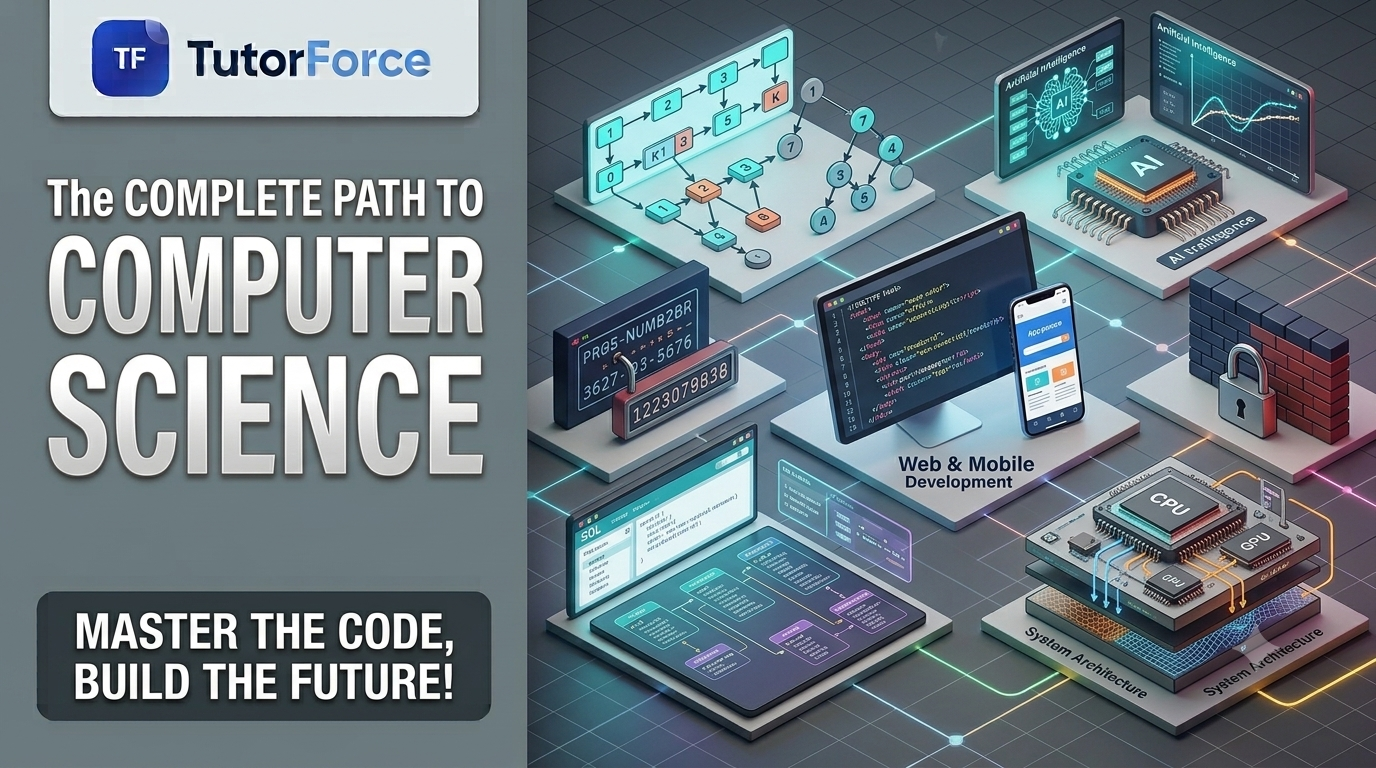
Computational Thinking and Programming Fundamentals: Variables, control flow (loops, conditionals), modular functions, and object-oriented programming (OOP) principles.
-
Data Structures and Algorithms: Working with arrays, lists, stacks, queues, trees, and graphs, alongside analyzing algorithm efficiency using Big O notation.
-
Computer Architecture and Operating Systems: How hardware executes instruction sets, memory management (RAM, caching), processes, and low-level system interactions.
-
Database Systems and Data Management: Relational database design, writing SQL queries, normalization, and an introduction to non-relational (NoSQL) data storage.
-
Software Development Lifecycle and Web Foundations: Version control (Git), software testing/debugging, and basic client-server communication protocols (HTTP, REST APIs).
FAQ
-
Do I need prior coding experience to take this course? No. The course begins with core algorithmic logic and problem-solving concepts before transitioning into writing and building actual code.
-
Which programming language is best to start with? Languages like Python are ideal for learning fundamental logic due to clean syntax, while languages like Java or C++ are great for understanding object-oriented structures and low-level memory concepts.
-
How does Computer Science differ from Information Technology (IT)? Computer Science focuses on designing, building, and optimizing software and algorithms. IT primarily focuses on installing, maintaining, and supporting existing computer systems and networks.
Student Ratings & Reviews