
Course Description
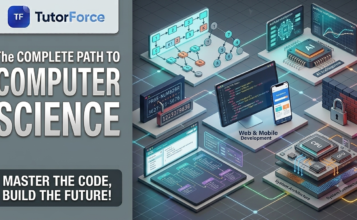
This course provides a comprehensive introduction to writing clean, efficient, and maintainable code. Moving past theoretical computation, you will learn how to translate human logic into machine instructions, master fundamental syntax structures across languages, and build robust software applications from scratch. This curriculum equips you with the hands-on engineering habits needed to write production-grade code and solve complex programming challenges.
Core Topics
-
Variables, Data Types, and Operators: Storing information, understanding primitive vs. reference types (integers, floats, strings, booleans), and performing mathematical and logical operations.
-
Control Flow and Logic Structures: Making decisions with conditional statements (
if,else,switch) and automating repetitive tasks with loops (for,while). -
Functions and Modular Architecture: Writing reusable blocks of code, understanding scope (local vs. global variables), parameter passing, and returning values.
-
Data Structures in Code: Organizing collections of data using arrays, lists, dictionaries/hash maps, and custom data objects.
-
Error Handling and Debugging: Identifying syntax, runtime, and logical errors, utilizing debuggers, writing try-catch exception blocks, and practicing clean code hygiene.
FAQ
-
What is the difference between programming and computer science? Programming is the practical craft of writing, testing, and maintaining code to build software. Computer Science is the broader academic study of algorithms, data structures, computational limits, and how computers process information.
-
Which programming language should I learn first? Languages like Python or JavaScript are excellent starting points due to their readable syntax, versatility, and massive community support, allowing you to focus on logic rather than complex low-level memory management.
-
What is the best way to become a better programmer? Build projects. While reading and watching tutorials are helpful, true fluency comes from writing your own code, breaking things, and actively debugging errors yourself.
Student Ratings & Reviews