
Course Description
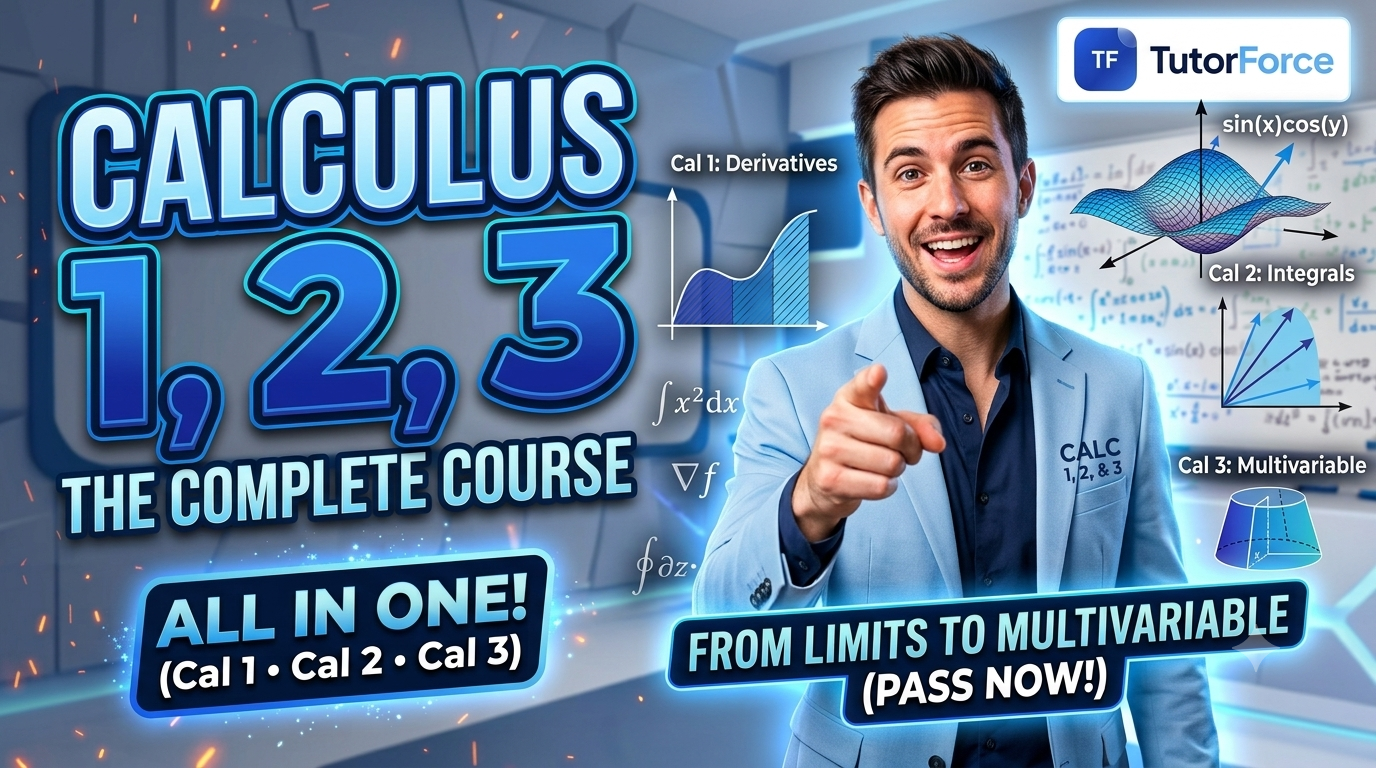
This comprehensive mastercourse bridges the gap between static algebra and dynamic reality. Calculus provides the language to describe, model, and predict change. By unifying the concepts of accumulation (integration) and instantaneous change (differentiation), this course equips you with the analytical tools necessary to solve complex problems in physics, engineering, economics, and data science.
Core Topics
-
The Continuum and Limits: Defining the foundational mathematical boundaries that allow us to calculate changes over infinitely small intervals.
-
Rate of Change (The Derivative): Mastering how variables change relative to one another, optimizing systems, and finding maximum efficiency points.
-
Accumulation (The Integral): Reversing differentiation to calculate total net change, areas beneath complex curves, volumes of irregular shapes, and physical work.
-
Infinite Approximations (Sequences and Series): Using infinite sums and polynomials to break down, model, and approximate complex transcendental functions.
-
Multi-Dimensional Space (Vector Calculus): Expanding equations of change into 3D environments to analyze fluid flow, gravitational fields, and electromagnetic forces.
FAQ
-
Do I have to take Calculus courses in order? Yes. Calculus is strictly cumulative. You cannot understand the integration techniques of Calculus 2 without the derivative mechanics of Calculus 1, and Calculus 3 requires a solid grasp of both.
-
What makes Calculus fundamentally different from Algebra or Geometry? Algebra and geometry deal with static objects and constant rates (like the area of a perfect rectangle or a constant speed). Calculus introduces variables that change continuously over time or space (like the volume of a melting snowball or a rocket’s acceleration).
-
What are the primary real-world applications of Calculus? It is everywhere. It runs the optimization algorithms behind machine learning, predicts market fluctuations in quantitative finance, determines trajectories in aerospace engineering, and models the spread of diseases in epidemiology.
Student Ratings & Reviews