
Course Description
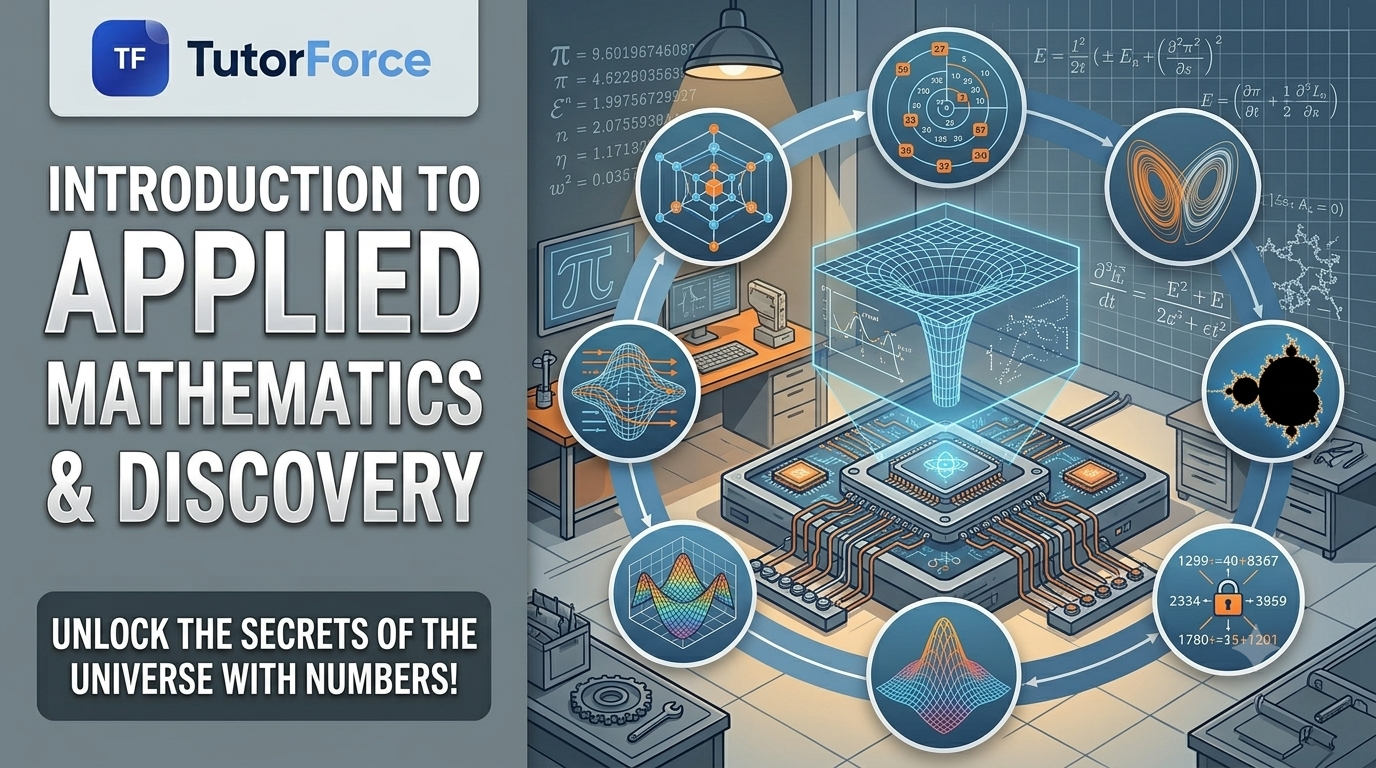
This course lays the comprehensive foundation for understanding quantitative structures, spatial relations, and logical reasoning. Designed to build mathematical confidence and rigor, the curriculum takes you from essential algebraic operations and geometric proofs through to data analysis, discrete logic, and introductory calculus. You will learn to translate complex real-world challenges into precise mathematical models and solve them systematically.
Core Topics
-
Algebraic Structures and Equations: Polynomials, rational expressions, linear systems, inequalities, quadratic equations, and exponential/logarithmic functions.
-
Geometry and Trigonometry: Synthetic and coordinate geometry, geometric proofs, planar transformations, right-triangle trigonometry, and analytic trigonometric identities.
-
Functions and Modeling: Analysis of functions (domain, range, transformations, and inverses) and modeling real-world phenomena with mathematical equations.
-
Probability and Statistics: Combinatorics (permutations and combinations), basic probability rules, descriptive statistics, and interpreting data distributions.
-
Discrete Mathematics and Logic: Propositional logic, set theory, proof techniques (induction, contradiction), and discrete structures used in computational thinking.
FAQ
-
What background knowledge do I need before taking this course? Basic arithmetic operations, working knowledge of fractions and decimals, and introductory middle-school algebra are sufficient starting points.
-
How will this course help if I am pursuing computer science or data science? Mathematics is the language of computer science. Topics like logic, set theory, functions, and probability directly underpin algorithms, data structures, and machine learning models.
-
How can I improve my mathematical problem-solving skills? Focus on understanding why a rule works rather than just memorizing steps. Practice breaking large, complex word problems down into smaller algebraic components.
Student Ratings & Reviews