
Course Description
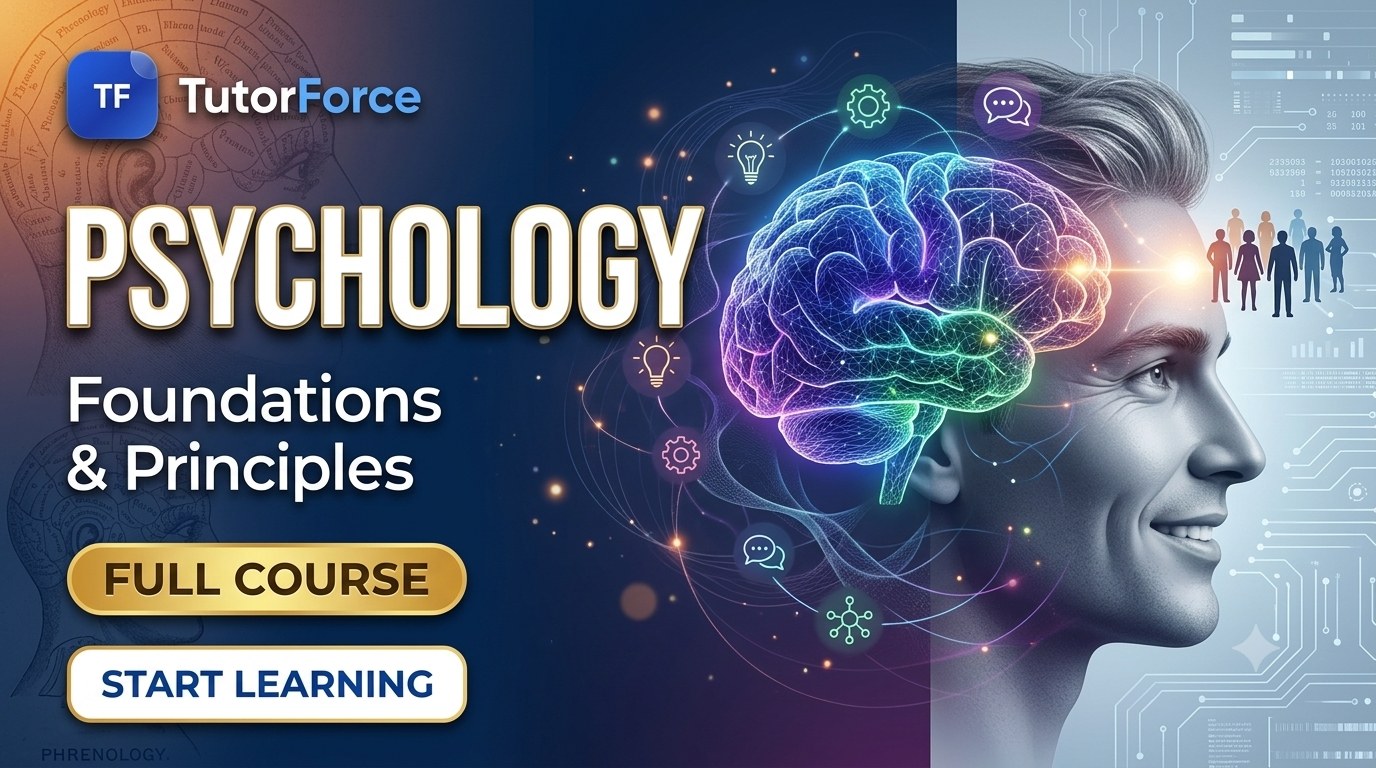
This course provides a comprehensive introduction to the scientific study of human behavior and mental processes. Exploring everything from the biological wiring of the brain to social interactions and behavioral psychology, you will examine how individuals perceive the world, learn, remember, develop across a lifespan, and experience mental health. This curriculum equips you with empirical insights into what drives human actions, thoughts, and emotions.
Core Topics
-
Research Methods and Biopsychology: Scientific research designs (experimental, correlational, observational), neural communication, brain structures, and the impact of the endocrine and nervous systems on behavior.
-
Sensation, Perception, and Consciousness: How sensory organs gather stimuli, how the brain interprets that information, states of consciousness, sleep cycles, and the effects of psychoactive substances.
-
Learning, Memory, and Cognition: Classical and operant conditioning, observational learning, information-processing memory models, encoding, retrieval failures, and problem-solving heuristics.
-
Lifespan Development and Motivation/Emotion: Physical, cognitive, and social development from infancy to old age, alongside core motivational theories and emotional processing.
-
Personality, Psychological Disorders, and Social Psychology: Major personality theories, criteria for psychological disorders (DSM framework), therapeutic approaches, and social influence, conformity, and group dynamics.
FAQ
-
Is psychology considered a hard science? Yes. Modern psychology relies heavily on the scientific method, rigorous laboratory experiments, neuroimaging, statistical data analysis, and peer-reviewed empirical research to test hypotheses about behavior.
-
What is the difference between a psychologist and a psychiatrist? A psychologist holds a graduate degree (Ph.D. or Psy.D.) and specializes in psychotherapy, behavioral assessment, and psychological testing. A psychiatrist is a medical doctor (M.D. or D.O.) who specializes in mental health and is licensed to prescribe medication and evaluate medical causes for psychological conditions.
-
How does understanding psychology help in other fields? Psychological principles are foundational for effective communication, marketing and consumer behavior, leadership and management, UX/UI design, education, and human-computer interaction.
Student Ratings & Reviews