
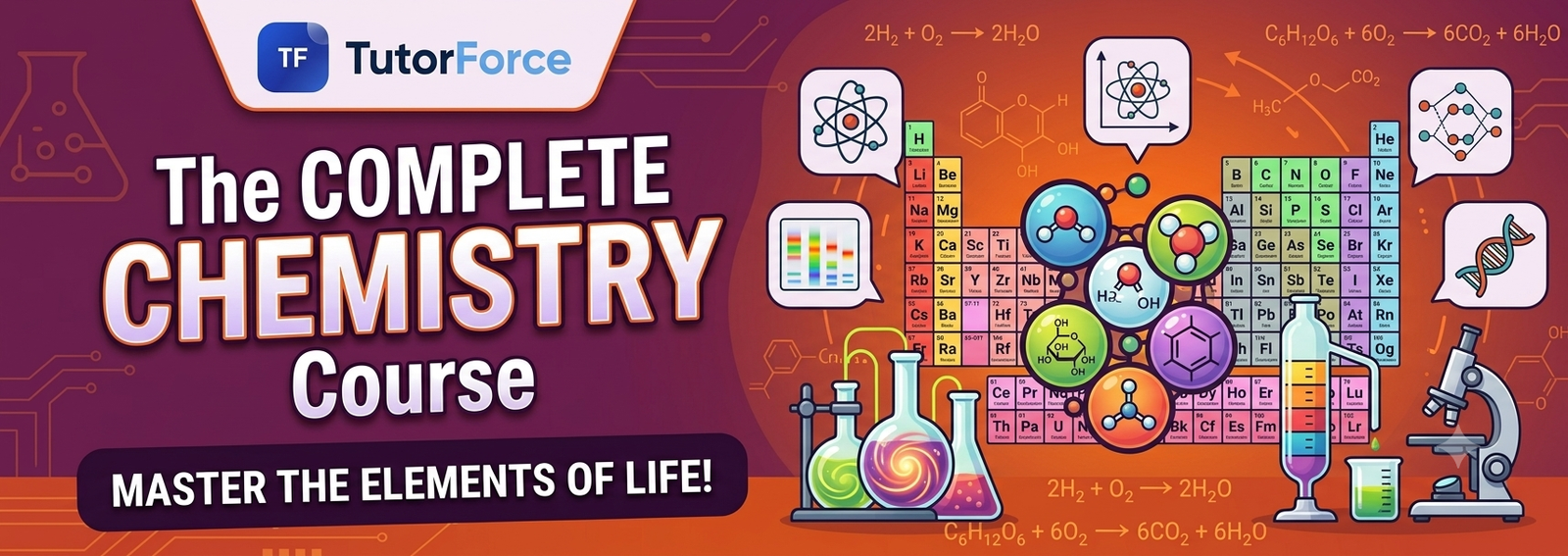
Course Description
This course explores the fundamental nature of matter and the chemical changes it undergoes. You will dive into the microscopic universe to understand how atoms bond, how energy drives chemical transformations, and how molecular structures dictate the properties of the physical world. This curriculum bridges theoretical atomic physics with the practical, hands-on science of chemical reactions.
Core Topics
-
Atomic Structure and Periodicity: The quantum mechanical model of the atom, electron configurations, and periodic trends like electronegativity and ionization energy.
-
Chemical Bonding and Molecular Geometry: Ionic, covalent, and metallic bonding, Lewis structures, VSEPR theory for molecular shapes, and hybridization.
-
Stoichiometry and Chemical Equations: Balancing reactions, calculating theoretical yields, limiting reactants, and working with solution concentration (molarity).
-
Chemical Thermodynamics and Kinetics: Energy changes in reactions (enthalpy, entropy, and Gibbs free energy), heat capacity, and the factors affecting reaction rates.
-
Chemical Equilibrium and Acid-Base Chemistry: Le Chatelier’s principle, equilibrium constants ($K_c$ and $K_p$), pH scales, buffers, and titration calculations.
FAQ
-
What is the most challenging part of Chemistry? Many students struggle with the transition between the highly abstract (visualizing subatomic orbitals) and the highly mathematical (stoichiometric conversions and thermodynamic calculations).
-
How much math do I need to know? You do not need calculus, but you must be incredibly comfortable with college algebra, dimensional analysis (unit conversions), scientific notation, and logarithms (for pH calculations).
-
Why is General Chemistry often required for pre-med and biology majors? Chemistry is the “central science.” You cannot deeply understand cellular biology, pharmacology, or metabolic pathways without first understanding molecular structure, equilibrium, and how chemical bonds break and form.
Student Ratings & Reviews